Private Limited vs LLP vs Sole Proprietorship: Which is Best in 2026?
It is easier than ever to start a business in 2026, but the decision regarding the most suitable business structure remains one of the most significant. The decision you make will influence how you are taxed, whether you are a freelancer, founder of a startup, or own a small business, and your future growth.
When you want to register a company in India, it is necessary to understand the distinction between the two structures. To help guide your choice, this guide will compare LLP vs Private Limited vs Sole Proprietorship, allowing you to select the best business structure in India.
The Importance of Selecting an Appropriate Business Structure.
Your business organization influences:
- Legal liability
- Taxation system
- Funding capability
- Compliance requirements
- Business credibility
That is the reason why most entrepreneurs seek the advice of a firm registration consultant in Delhi, such as The Advice Brain, beforehand.
With that context in mind, let’s explore the key business structures found in India.
- Sole Proprietorship
The most basic type of business is a sole proprietorship, and it is the type of business owned and operated by one person.
Recommended to: small shop owners, local businesses, freelancers.
Advantages:
- Easy to start
- Low cost
- Minimal compliance
- Full control
Disadvantages:
- Unlimited liability
- No separate legal identity
- Limited growth potential
- Limited Liability Partnership (LLP).
LPP is a partnership and corporate structure that has limited liability.
Best in: Professionals, agencies, service-based businesses.
Advantages:
- Limited liability protection
- Separate legal entity
- Minor compliance compared with businesses.
- Flexible structure
Disadvantages:
- Limited funding options
- No shareholding system
- Not good with high-growth startups.
LLP registration in Delhi is favoured by many businesses because of its cost-compliance balance.
- Private Limited Company
The most organised and expandable form of business is a Private Limited Company.
Best: Startups, funded businesses, and scalable ventures.
Advantages:
- Easy to raise funds
- Limited liability
- High credibility
- Suitable for growth
Disadvantages:
- Higher compliance
- Mandatory audits
- Costly setup
This is generally believed to be the most suitable business structure in India when starting up.
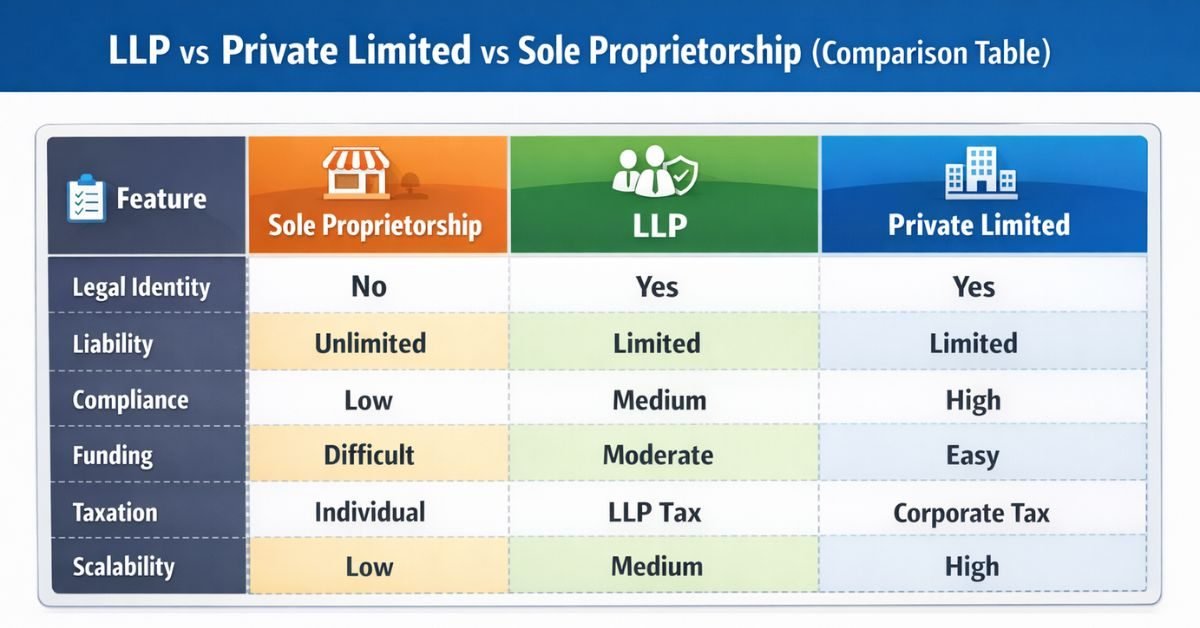
Which is the Best Business Structure in India in 2026?
This is based on the goals of your business:
Choose Sole Proprietorship if:
You are starting small.
You desire low investment.
You do not require financing.
Choose LLP if:
You have business associates.
You desire limited liability.
You require moderate obedience.
Select Private Limited when:
You would like to grow your business.
You are going to fund-raise.
You desire a good brand credibility.
Registration of a company in India: Step-by-step.
Select business structure
Apply for a DSC (Digital Signature Certificate).
Get DIN (Director Identification Number)
Reserve company name
File incorporation documents
Receive Certificate of Incorporation.
PAN, TAN and GST application.
Having a company registration consultant in Delhi can assist you in taking this process in a short time and without mistakes.
Why Select The Advise Brain?
The Advise Brain is a reputable company registration advisor in Delhi that assists business persons to open their businesses with ease.
Services Offered:
Registration of the company in India.
LLP registration in Delhi.
Setting up a Limited company privately.
Legal compliance support
📞 Contact: +91-7217863964
Final Verdict
In 2026, there can be no single-fits-all solution:
Sole Proprietorship Small businesses.
Partnerships → LLP
New businesses and those that are scalable: Private Limited.
By selecting the appropriate structure at the outset, you may potentially save on time, money and lawsuits ahead.
FAQs
Q.1 Better LLP or Private Limited?
The advantages of the Private Limited are more funding and scalability, whereas the LLP is applicable to low-compliance businesses.
Q.2 What is the lowest cost of business in India?
The least expensive one is a sole proprietorship.
Q.3 Is it possible to convert LLP to Private Limited?
Yes, it is possible to change LLP into a Private Limited Company in future.
Q.4 What is the cost of company registration in India?
Proprietorship: ₹1,000–₹5,000
LLP: ₹7,000–₹15,000
Private Limited: ₹10,000–₹25,000
Q.5 Should I secure the services of a consultant to do the registration of the company?
Not obligatory, but the employment of a firm registration consultant in Delhi will make the process unproblematic.